Ricky Ramsey is 47 years old. He owns a rig, delivering oilfield products like fracking sand. He makes a good living and he has a good life.
It wasn’t always this way. In his younger days, he checked lots of boxes on the stereotype list.
He was a high school dropout. He was a drug dealer. He went to prison in both Texas and Mississippi.
It’s quite a story, his transformation to a working man, made more compelling by his passionate opinions, based on his own experiences, of what McComb and Pike County can do to stop the string of shootings of teenagers by teenagers.
Ramsey believes many shootings could be prevented if a larger number of trusted adults, including law enforcement and private citizens, are willing to get involved.
Most of the shootings occur in public places like parks or nightclubs, he noted, where a police presence can make a difference.
His story makes his opinions about today’s problems more relevant — because when he was a teenager he was making plenty of mistakes.
“From around age 13, I was in the streets, me and my friends, stealing and taking stuff,” he said. “Back in the 1990s, everybody had a similar story of struggle.
“I looked up to the drug dealers. I was the youngest of five. My mother was a single mother. She did the best she could.
“I was introduced to selling crack in the eighth grade,” he recalled. “A kid came to school and he had a big wad of money. I said, ‘Where’d you get that?’ He said selling crack.
“At that point, then and there, I wanted to be a drug dealer.”
Talking to Ramsey, it’s easier to understand why selling drugs appealed to so many young people.
“My motivation for doing that — financially, we didn’t have nothing,” he said. “There would be days we didn’t have water. Days we didn’t have lights. I used to have to wear my older brother’s clothes. And I had never seen my mother go on a vacation.”
And yet, there were positive role models, which Ramsey would only recognize when he was older.
“I used to watch ‘The Cosby Show.’ The mother was there, the father was there,” he said. “They gave their kids allowances. They said, just go get your education and do what you’re supposed to do.”
It sounded great to Ramsey, but it wasn’t his life. In 10th grade, he got a job at McDonald’s but got fired. He dropped out of school after flunking that year. When he turned 18, he got a job at Sanderson Farms but quit after a month.
Being completely honest about it, he said he just hated school. Besides, the money from selling drugs was too much to pass up.
“I was a drug dealer, most definitely,” he said. “Went to the penitentiary on a drug charge in Texas when I was 18. I flew to Houston to purchase drugs and got caught with them at the bus station, trying to board a bus to come back to Mississippi.
“I ended up doing three years in prison out there, and I got out, came back to Mississippi, and it wasn’t six months later I was doing the same thing.”
Ramsey’s story gives him a good perspective on the problems some young Black men face today.
“When I was young, we looked up to the drug dealers,” he observed. “It was an ongoing cycle. We would lead each other to the penitentiary. So today, an eighth-grader looking up to his cousin or friend who’s a shooter more than likely will become a shooter himself.
“Another thing too is, I think as a society, we worry about the wrong things. My worry about these kids is them living long enough to realize their mistakes and changing their lives.”
If that’s the first concern, it means other decisions, even the bad ones like marijuana use, should be given less attention. Better to worry about the more important mission of keeping them alive.
So what can be done about these shootings, which occur all too regularly?
“There’s two things we can do,” Ramsey said. “People always talk about the parents, and that’s true. But when you leave out of your house, there’s nothing parents can do.”
After his own drug arrests, his mother asked him what she did wrong.
“Nothing,” he told her. “It was me.”
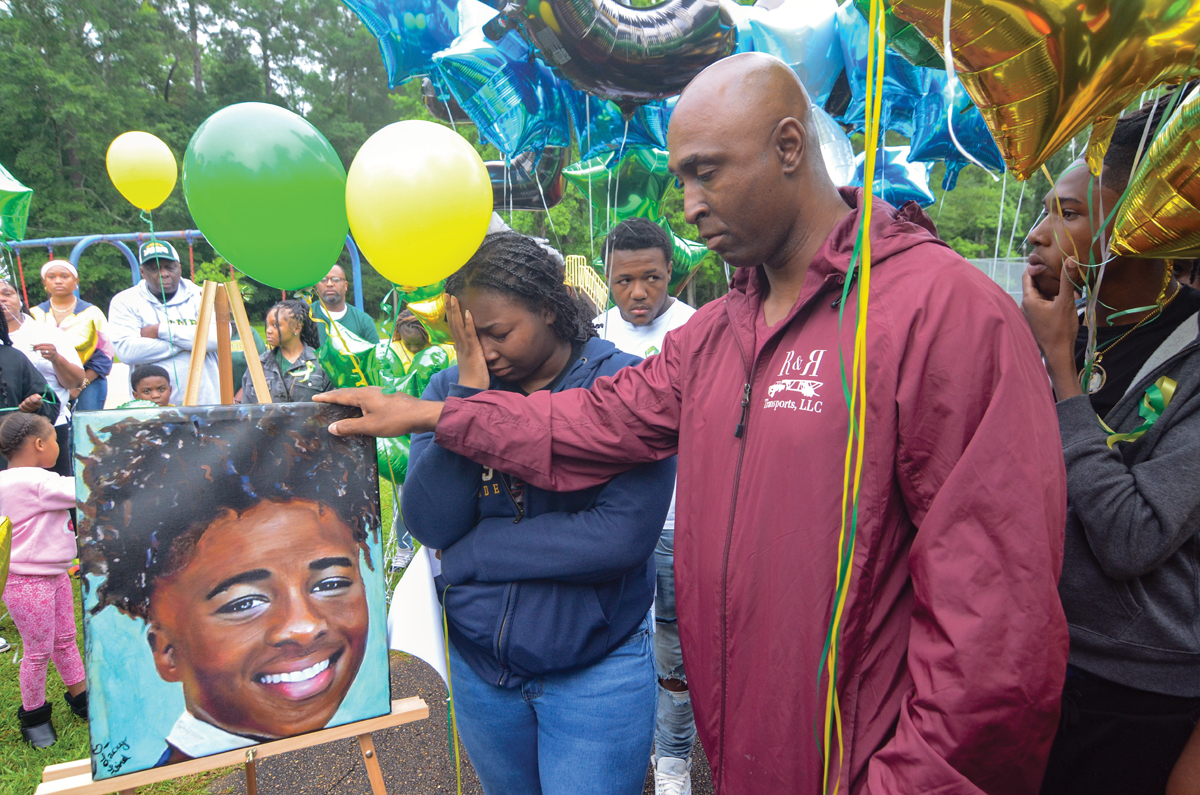 Ricky Ramsey touches a portrait of Gary Thompson at a memorial balloon release for the McComb High School junior at Baertown Park on May 9, a week after Thompson was shot and killed. Ramsey’s daughter Jayla, who was Thompson’s classmate, is also pictured. (Photo by Matt Williamson. Copyright 2025, Emmerich Newspapers, Inc.)
As for today, Ramsey said a police presence at public gatherings can be a significant deterrent to violence.
“We don’t have random killings,” Ramsey said. “Most of these kids know each other. We don’t have random carjackings. Most of these things can be contained.”
But Ramsey said the public should not expect police to shoulder the entire burden. He has taken off work and gone to parties that his 17-year-old daughters attended.
“I’m going to tell you what every child has,” he said. “A father. An uncle. A brother. A cousin. Sometimes a nephew. So if you got 50 kids at a party, you telling me we can’t get 10 adult men there? Why not put stuff in place to prevent killings instead of sitting back and waiting? You can make an arrest, get a conviction, but you still got a grieving family and a grieving community, so why not try to prevent that?”
Ramsey didn’t know it at the time, but that drug arrest in Houston was the first step in his move toward the man he wanted to be.
Since he was from Mississippi, a judge denied bond, calling him a flight risk. Another inmate told Ramsey about an expensive lawyer he knew who could get him out on bond.
Ramsey didn’t want to do it, but he had to call his mother, Estelle Ramsey. She had no idea he was dealing, or that he had a safe in her house with cash and drugs.
He needed her to bring his hidden cash to Texas to post bond, and to sign an agreement to be responsible for making sure her son returned to court.
That call from jail to his mother stays with him even now, nearly 30 years later.
“When she answered that phone and said, ‘Ricky,’ I felt her soul leave her body,” Ramsey said. “She went to cussing and crying, and the only thing I could say was, ‘Mama, you cannot talk like that on this phone.’ I knew the call was being recorded.”
Even then, there was a hint of hope for Ramsey. He had done some just-in-case planning.
He had hidden money in his mother’s house for things like bond, attorney fees and the prison commissary, all of which he was sure he would need one day.
“When I jumped in the street and sold drugs, I knew I was going to prison,” he said. “So I saved money for a bail bondsman and a lawyer, and to take care of myself in prison.
“My thing was, why should I get $30,000 or $40,000 a year from a job when I could get that in a week? Just because you make that doesn’t mean you save it. From the time I picked up those drugs, I knew I was going to the penitentiary. That’s what I signed up for.”
His mother used some of that hidden cash to post bond for her son. He came home, then returned to Texas to start his prison sentence. That’s where he learned something useful: a trade.
“When I got locked up in Texas, they had the fields that they took you out to work in, and in order to keep from going to work in the fields, you had to go to regular school, college or the trade schools,” he said. “I said I was gonna take the welding.
“The instructor said, ‘I know a lot of you came into this to get out of the fields. But I’m telling you, if you take this seriously, you’ll never work for minimum wage again.’ ”
It was a life lesson, and he remains a big advocate of job training today.
“One thing about a trade, you’re not coming out of that owing the government,” he said, referring to college education debts that many young people take on. “Within a year or two of that, you’ll be a six-figure person. You’ll be set for life.”
Ramsey has done more than talk about how McComb can get kids to put down their guns. He’s set up events at local parks where people can just get together and have a good time.
“It’s nice to see these kids, you remember the 1990s or the 1980s, kids outside just playing, and that’s what you see at these events,” he said.
After a string of shootings in 2022, Ramsey, Eric Brumfield and Esha “Sway Way” Robinson set up Family Day at the Park. They call their group Team Us, to represent the community.
“It’s a great event,” Ramsey said. “I tell people, it’s a great event to get to know these kids and young adults. And it’s on neutral ground.
“This will be the third year of this event. It starts in April, and we go from park to park every month till August because some parks are closer for kids to walk to than others.
“At these events, people bring their grills, their cooking pots, their tents. Some people come out and sell food. Some people cook a lot of food to give away. We play games with the kids.
“It’s not a family picnic where everything is perfect; it’s a cookout where everyday, ordinary people just come and be, and get to know each other.”
“These kids are just carefree out there. They’re just running around and playing.
Ramsey said he invites police officers, city officials, churches and everyone of all races to the events. He credited Mayor Quordiniah Lockley, selectwomen Terri Waterman Baylor and Tabitha Felder Isaac, Pike County Supervisor Justin Lofton and state Rep. Daryl Porter for regular attendance. Walker’s Chapel Church members have attended as well.
In two years, he said, police have only showed up when the event was in Edgewood Park. He wishes officers attended more regularly to get to know the community they’re policing.
“Every era has something going on in the streets,” he said. “In the 1990s it was drugs. This era is a killing era. We’ve got to do something about that. This is a deadly era. We can prevent a lot of this stuff, prevent these kids from shooting into crowds.”
As for safety at the cookouts, “The only person that’s out there is my security guard, Will Weathersby,” Ramsey said. “He’s been with me since we started doing this stuff. I invite the police to come, and just be there to be present.”
He thinks a visible police presence around other teenage gatherings would help, but believes it’s more important for other men to be there, too.
Ramsey thinks people planning parties at event centers should let the police department know about it in advance. When a party on private property is ending, a police car outside with its blue lights on would encourage people to leave instead of hanging around and increasing the risk of trouble.
Ramsey’s second drug arrest was in the early 2000s in Pike County. Back then, Mississippi had a “truth in sentencing” law that required most felons to serve at least 85 percent of their sentence. But the extra time didn’t stop him from breaking the law.
“People took their chances. People knew,” he said. His thinking was, “I’ll still be young when I get out of prison.”
He got a 28-year sentence, but it got reduced. He wound up serving four years and seven months.
“And during that time, man, I tell people about growth,” he recalled. “Growth hits people at different times.”
It hit him when he lied to his 8-year-old daughter on a smuggled cellphone about how long he would be in jail.
“Something just went off in me,” he said. “I asked God to take that time off me, bring me back to my kids. You ain’t ever got to worry about me selling drugs again.
“I always wanted to be the best father ever. And you can’t be in prison and be a good father. God, He gets your attention through different things. He got my attention through my child.”
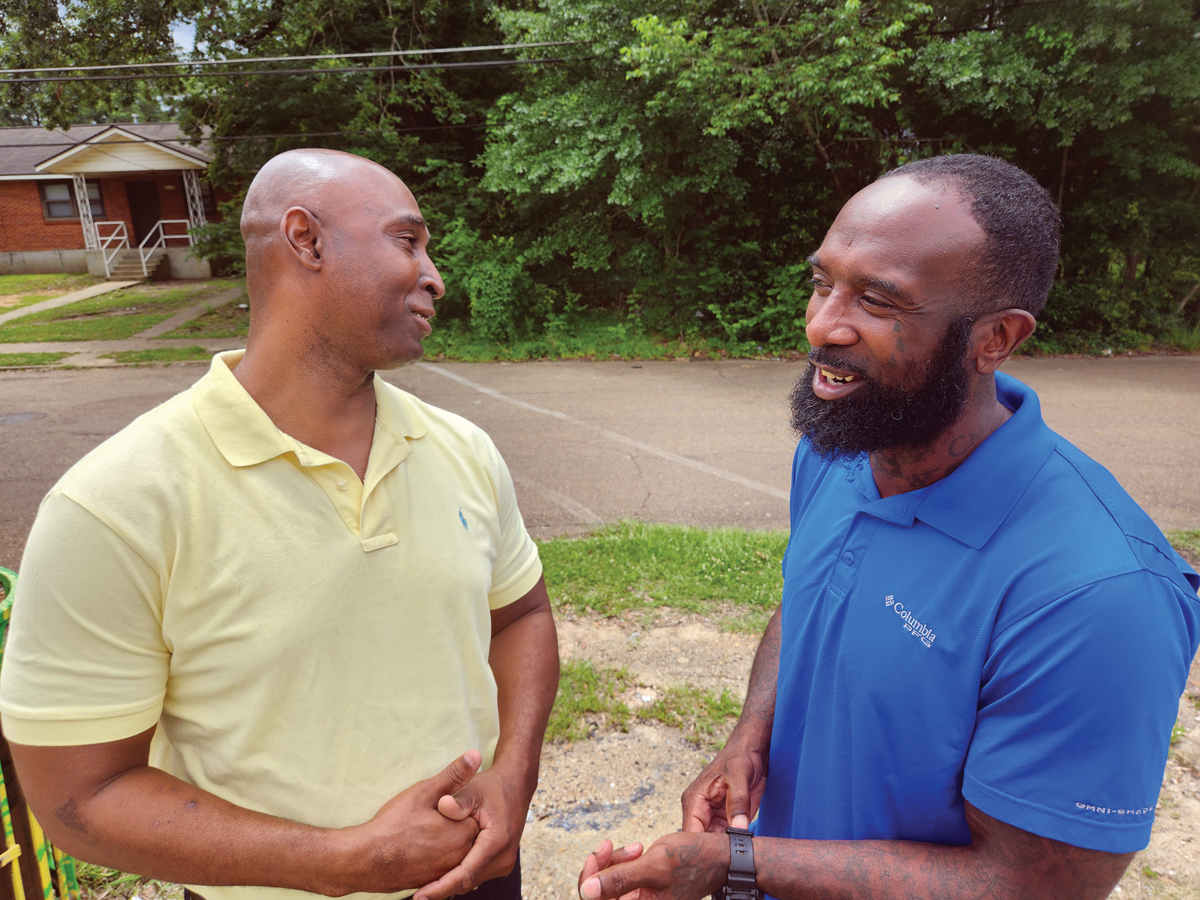 Ricky Ramsey and lifelong friend Jermaine Henderson, who helps put together the Family Day in the Park events. Like Ramsey, Henderson spent time in prison and now mentors teenagers and young adults. (Photo by Jack Ryan. Copyright 2025, Emmerich Newspapers, Inc.)
The second trip behind bars gave Ramsey time to compare the person he was to the man he wanted to be.
“I didn’t have a father growing up, and I know the struggle my mother went through with me and my siblings,” he said. “I was like, my kids will never experience that, ever.
“These things that I was doing out on the streets, it was affecting the people that I love. So I knew I had to make a change.”
And that was the end of his drug business.
“It does bother me. I did help to destroy my community. I did play a part in that,” he said. “That’s why I am trying to be more of a positive role model in the community, and to young people in the streets.
“Back in the 1990s, you had drug dealers that took care of families that weren’t theirs. Bought kids clothes. I treated people with respect. At that time, I felt that for my wrong, I’m doing some right.
“At the end of the day, it was wrong. But I don’t regret nothing that took place, because it made me the man I am today, the father I am today.
“You know what I also tell people? Pike County, how many pharmacies do you have? People are going to get these drugs regardless. You are not going to stop a person from getting high. That’s why I tell people drugs are not our problem.
“People are not scared of their neighbor using drugs. They’re scared of these gunshots.”
After his second stint in prison, Ramsey was a changed man. He co-owned a nightclub and did some pipeline work. In 2017 he got into the trucking business, where he works today.
As for his four daughters, two of them are college graduates. The younger two, 17-year-old twins, also plan to attend after high school. (A fifth daughter died of pneumonia at age 4 in 2002.) A stepdaughter also is a college graduate.
“I can only guide them, and I can only tell them what they should be doing,” he said. “That was another reason I got out of the streets.
“I couldn’t tell my daughter not to date a drug dealer when I was still selling drugs: You don’t need a man like I used to be, you want the man that I am now. Every time you think about dating a person that’s in the streets, just remember, your daddy wasn’t there, missed out on a lot of your life for being in the streets.’”
He also was ready to help build his community.
“I got to thinking how I could be more productive,” he added. “No drug dealer that I could think of went to prison, changed their life and tried to save the kids coming behind us. I stayed in tune with the streets. I talked to the teenagers and young adults a lot.”
There are successes and failures.
“When a lot of the shooting was going on, I talked to these young brothers,” Ramsey said. “And one, he was doing things all the time, but he wanted to come out of the streets.”
Ramsey advised him to leave town because his past would catch up with him. The young man was happy that he had found a job, but Ramsey warned him that he couldn’t bring a gun to work, “and just because you’re tired of playing, your opponent isn’t tired of playing.”
“I’m through with all that,” he told Ramsey.
A few weeks later, Ramsey got a phone call that the young man had been shot and killed while leaving work.
Ramsey cried, asking God why he had to care so much.
“A week later, God answered my question,” he said. “A young guy messaged me, told me he listened to my videos, and what I was saying changed his life. He got out the streets, he went to truck driving school and started respecting his mother more.
“I said, OK, I hear you, God. If I can just reach one.”
Ramsey knows that stopping the shooting is a big challenge.
“Man, these kids, young guys, don’t have no fear,” he said. “It’s just like in the 1990s: We became immune to people selling drugs. In this era, it’s common to see a friend with a gun. They’re used to it. That’s the worst thing. That’s what makes it so bad.
“And reality doesn’t kick in till you get arrested for murder. Or when the judge gives you 30 years or a life sentence, and it’s too late.
“There are so many things we can do,” he added. “The presence of men is important. The women have tried. The men got to step back up.”
The presence of adults that kids know and respect will do much more than the police presence.
“It’s a lot of guys that help,” he added. “But it’s not enough.
“In my circle, there’s probably about five of us, that were in the streets and turned their lives around. But you got others that are mentors at the schools, and mentors at the churches. ... I know people in the school system, they are real effective with kids. I know people in churches, they’re real effective. But it’s not enough people who realize it’s their presence that matters.
“Yes, we need to raise these kids right, most definitely. But I think in order to prevent a lot of these killings, we need police presence and the presence of men.”


